

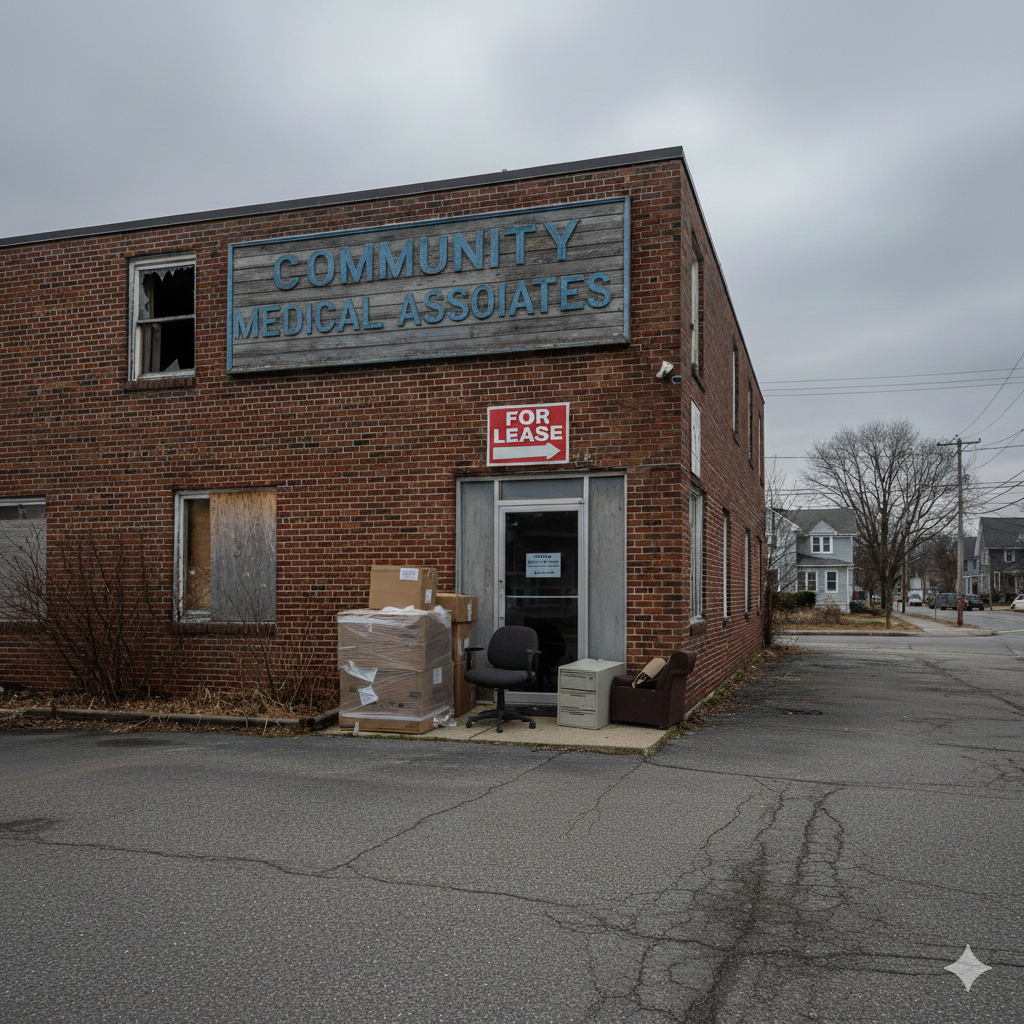
Picture a medical practice in western Massachusetts. Four locations. Ninety providers — doctors, nurse practitioners, physician assistants. On-site labs, x-rays, vision care. Tens of thousands of patients. A waiting list so long that frustrated residents post on community forums asking how to get in.
Valley Medical Group has been a cornerstone of family medicine in the Connecticut River valley since the 1990s. It forms a key part of the region's healthcare infrastructure. And in January 2026, they laid off 40 employees — 10 percent of their 400-person staff.
Not because patients stopped coming. Not because the doctors stopped caring. But because the financial model that was supposed to support all of it is quietly falling apart.
"It has to do with the fact that our contracts don't pay as well as we think they should," said Dr. Paul Carlan, the group's CEO, in a February 2026 NPR report. "The cost of everything is going up."
Valley Medical Group is not an outlier. They are a warning sign. And what they're doing next tells you everything about where independent primary care is headed.

Community primary care practices form the backbone of local healthcare access — yet many are fighting for survival.
The Numbers Behind a Quiet Emergency
The Valley Medical story isn't an anomaly — it's a symptom of something systemic. The data tells a story the industry has been avoiding for years.
That last number is the one that keeps healthcare economists up at night. Primary care only receives 4.5 cents of every dollar spent on healthcare in America. Meanwhile, administrative costs keep climbing, staffing costs are up 63% since 2019, and insurance reimbursement rates have stayed largely flat.
In 2024, federal research support for primary care fell to just $115 million — representing only 0.31% of total federal research funding. The Milbank Memorial Fund called it a "new low" and warned that without meaningful investment, the modest workforce improvements seen recently are unlikely to persist.
Why the Money Isn't Working Anymore
To understand why practices like Valley Medical are struggling, you have to understand how primary care gets paid. And the short answer is: not well, and not in a way that reflects what primary care actually does.
The traditional model — fee-for-service — pays practices for each visit, each test, each procedure. On paper, that sounds fair. In practice, it creates a system where a 15-minute appointment might generate $150 in reimbursement, but the same practice just spent $400 in overhead to deliver that appointment.

The gap between what insurance pays and what it costs to deliver care is growing every year.
The numbers are unambiguous: primary care doctors earn significantly less than their specialist colleagues. Medical students have noticed. The proportion of new physicians entering primary care has been declining for decades — though the 2026 Milbank Scorecard shows a slight uptick to 22%, up from 18.6%, which is encouraging but fragile.
Then there's Medicaid. NPR's February 2026 report on Valley Medical specifically flagged the incoming Republican-backed Medicaid cuts as a material threat to primary care revenue — "projected to get even worse," the report noted. For practices in lower-income communities where Medicaid represents a significant share of the patient panel, these cuts aren't an abstraction. They're an existential threat.
"Hospitals get paid when their beds are full. Our priorities get muddled up when you're part of a health system. You're constantly being asked to bend for the needs of the organization."
— Dr. Paul Carlan, CEO, Valley Medical Group (NPR, February 2026)
This is the core tension. Merge with a hospital system and you get financial stability — but you lose the autonomy to make the best decisions for your patients. Stay independent and you keep that autonomy — but you fight the financial headwinds alone.
Banding Together: The IPA Movement Gains Momentum
Valley Medical Group chose a third path. Rather than sell to a hospital system, they joined Arches Medical IPA — an Independent Physician Association owned entirely by physicians and focused on value-based contracting.
An IPA functions somewhat like a union for independent practices. It aggregates patient panels across multiple independent practices, giving them the collective size to negotiate value-based contracts with insurers that individual practices could never achieve alone.

Independent Physician Associations give solo practices the collective bargaining power of much larger organizations.
The data shows the IPA model is gaining traction. A Black Book Research poll of 496 practices found that 16% have already joined IPAs, MSOs, or ACOs while retaining independent governance. Another 28% have signed new value-based contracts with payers or CMS as of July 2025.
Value-based contracts flip the financial model. Instead of getting paid per visit, the practice receives a budgeted amount per patient per year. The incentive shifts from volume to outcomes. Keep your patients healthy, keep them out of the ER, prevent unnecessary hospitalizations — and the savings get shared between the practice and the insurer.
🏆 The Value-Based Promise
Of independent practices have already signed value-based contracts with payers or CMS as of July 2025 — up significantly from prior years as IPAs gain collective bargaining power.
"If we keep people out of the ER, keep them out of unnecessary hospitalizations, we save money for the system. And we create more income for the PCPs — which is dreadfully needed." — Chris Kryder, CEO, Arches Medical IPA
But here's the honest truth about value-based contracts that most industry coverage glosses over: they take time. The lag between delivering care and realizing the financial savings can exceed a year. Valley Medical had to lay off staff after joining the Arches IPA — not despite the decision, but partly because of the transition period before savings materialize.
IPAs also aren't all created equal. The American Academy of Family Physicians advises members to carefully evaluate IPAs before joining — some are owned by hospital systems or private equity and are far less focused on physician autonomy than they appear.
The Operational Bleeding Nobody Is Measuring
While the industry debates reimbursement models and IPA formation — important conversations, both — there is a quieter crisis happening inside independent practices that rarely makes the headlines.
Revenue leakage. Silent, constant, largely unmeasured operational waste that compounds the reimbursement problem to the point where even a well-managed practice can find itself laying off 10% of its staff despite having a full waiting room.
MGMA's January 2026 poll of practice leaders put numbers to what most practice managers already feel:
| Revenue Leak Source | % of Practices Affected | Primary Driver | Annual Impact |
|---|---|---|---|
| Denials & Appeals | 48% | Coding errors, prior auth failures, payer disputes | $100K–$200K per provider |
| Front-End Issues | 23% | Phone access, scheduling, registration failures | Unmeasured in most practices |
| No-Shows & Cancellations | 14% | No reminders, poor patient communication | 14% of total group revenue |
| Missed After-Hours Calls | Est. 60%+ | Staff unavailable, calls go to voicemail | New patient acquisition loss |
That front-end number deserves more attention than it gets. Twenty-three percent of revenue cycle leakage comes from the front door — scheduling, registration, patient access. Not from complex payer disputes or billing errors. From the phone not being answered. From the patient who couldn't get through and called someone else.
Research from healow Genie found that 60% of patients abandon a call after waiting just one minute. In a primary care practice already stretched thin — where the front desk is managing check-ins, insurance verifications, and patient questions simultaneously — one minute of hold time is not unusual. It's the baseline.
And what happens when that patient abandons the call? In 2026, they don't try again later. They open Google, search your specialty in your area, and call the next practice on the list. You didn't just lose an appointment. You potentially lost a patient relationship worth years of lifetime value.

The front desk is the financial front line of every independent practice — yet most practices have no visibility into how many patients give up before getting through.
What the Practices That Are Surviving Are Doing Differently
Not every independent practice is in crisis. Some are not just surviving — they're growing. And the strategies they're using share a common thread: they've stopped waiting for the reimbursement environment to improve, and started controlling what they actually can control.
-
1
Joining IPAs for Collective Leverage
Using collective patient panels to negotiate value-based contracts with insurers — contracts that individual practices could never access alone. 16% of independents have already made this move (Black Book Research, 2025).
-
2
Automating Administrative Workflows
MGMA's January 2026 poll found automation is the #1 cost-cutting priority for medical practices this year. Practices are deploying automation for prior authorizations, billing follow-ups, and patient communications — freeing staff for higher-value work.
-
3
Capturing Every Patient Call — Including After Hours
Practices that have deployed 24/7 answering solutions are capturing new patient inquiries that previously went to voicemail and were never returned. The cost of missing a call isn't just one appointment — it's a patient relationship.
-
4
Aggressively Reducing No-Shows
No-shows consume 14% of medical group revenue (MGMA 2026). Practices using automated SMS and phone reminders report no-show rate reductions of 40–50%. That's not a small efficiency gain — it's a revenue recovery that directly offsets reimbursement cuts.
-
5
Competing on Patient Experience — Not Price
Independent practices cannot out-negotiate hospital systems with payers. But they can out-serve them. Shorter wait times, same-day appointments, personal relationships, direct physician access — these are advantages hospital-employed practices structurally cannot replicate.
The One Competitive Advantage Independents Actually Have
Here is a truth that often gets lost in the conversation about primary care's financial crisis: patients prefer independent practices. When they can access them.
The problem isn't quality. Independent practices routinely outperform hospital-employed groups on patient satisfaction measures. The problem is access. The phone lines are overwhelmed. Online scheduling is limited or nonexistent. After-hours calls go to an answering service that can only take messages. The patient experience gap isn't in the exam room — it's in everything that happens before the patient gets there.
❌ Where Independents Lose
- Reimbursement rate negotiations
- Administrative infrastructure
- Technology investment capacity
- After-hours coverage
- Staffing depth and redundancy
✅ Where Independents Win
- Patient relationships and trust
- Clinical autonomy and flexibility
- Personalized, unhurried care
- Community presence and loyalty
- Response time when systems work
The strategic implication is straightforward: if independent practices cannot compete on reimbursement rates, they must absolutely compete on patient experience. And patient experience starts with the phone. It continues through the scheduling process. It includes whether someone calls back within the hour or leaves a voicemail at 4:47 PM that doesn't get returned until the next morning.
The practices that are growing right now aren't the ones that negotiated a better insurance contract last year. They're the ones that fixed the operational gaps that were silently eroding their patient base while they were focused on everything else.

Independent practices have an inherent advantage in patient relationships — but only if patients can actually reach them.
The financial model for primary care is under genuine, structural pressure. IPAs are a meaningful response. Value-based contracts are a meaningful response. But while those systemic solutions unfold — and they take time, as Valley Medical is discovering firsthand — there is operational work that can be done today. Revenue that is being lost right now that doesn't require a policy change or a new payer contract to recover.
The practices that survive the next 18 months will be the ones that attacked both problems simultaneously: the external reimbursement environment through collective action, and the internal operational leakage through automation and better patient access infrastructure.
The ones that waited for one to be solved before addressing the other are the ones that ended up laying off staff despite having a full waiting room.
📊 Is Your Practice Leaking Revenue?
Find out exactly how much your practice is losing to missed calls, no-shows, and front-end operational gaps — and how much is recoverable.
Calculate My Hidden Revenue Loss →Takes 3 minutes. No credit card required. Transparent, evidence-based projections specific to your practice size and specialty.
📚 Sources & References
- NPR / New England Public Media / KFF Health News: "Primary care is in trouble. Doctors are banding together to survive." (February 16, 2026)
- AAMC: Addressing the Physician Workforce Shortage — Projected deficit of 86,000 physicians by 2036
- Milbank Memorial Fund: 2026 Primary Care Scorecard — Continued Underinvestment & Workforce Strain
- Black Book Research: Independent Physician Practices Struggle for Survival as Value-Based Care Expands (Q2 2025, n=496 practices)
- KFF: Medicaid — What to Watch in 2026
- KFF: What to Know About How Medicare Pays Physicians
- MGMA Stat: Detecting and Fixing Leaks Across the Revenue Cycle (January 6, 2026)
- MGMA Stat: Patient Access Priorities for 2026 — No-shows consume ~14% of medical group revenue
- MGMA Stat: Automation and Process Fixes Top List of Cost-Cutting Moves for Medical Practices in 2026 (January 27, 2026)
- healow Genie: Healthcare Call Center KPI Metrics — 60% of patients abandon calls after 1 minute wait
- Arches Medical IPA — Value-based contracting for independent primary care practices
- American Academy of Family Physicians: Independent Physician Associations — Guiding Principles